KINO
Multimodal Speaker Unit
Individual Project | 3 weeks





As domestic technology becomes more multifunctional, everyday devices can feel increasingly cold, sterile, and impersonal, creating a sense of disconnection from the character of the home.
What is KINO?
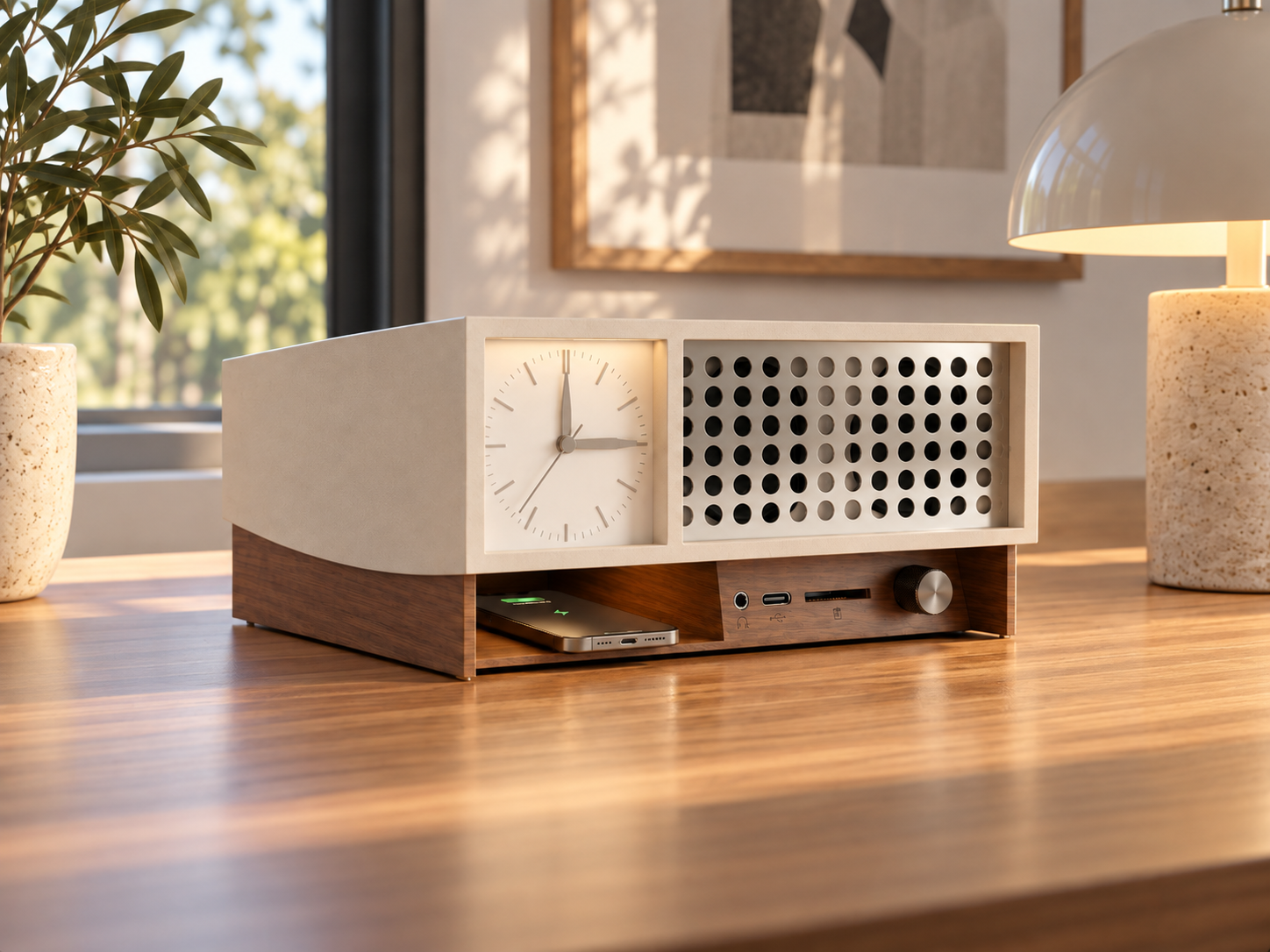
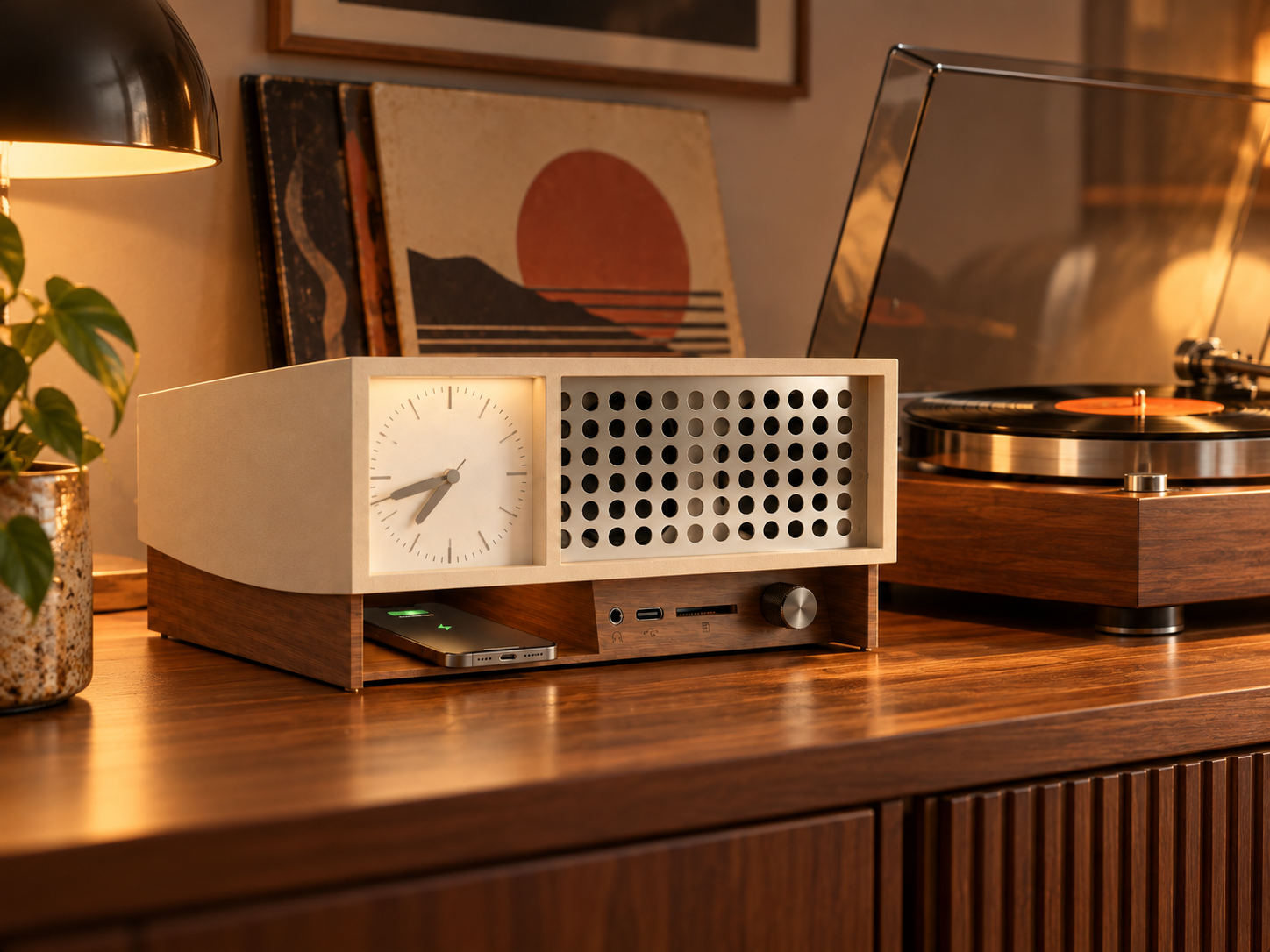
KINO is a multifunctional media unit that combines audio playback, wireless charging, and analogue timekeeping in one compact unit.
Inspired by 1970s hi-fi systems and architectural detailing, KINO explores how technical integration and everyday usability can be expressed through a restrained, nostalgic form.


Specifications
Dual 55 mm full-range drivers
Analogue clock with soft backlight
15 W wireless charging pad
AUX, USB-C, and SD card input
Rear DC power input
How might we combine audio, charging, and timekeeping in a single object that feels purposeful, calm, and emotionally familiar?
Aims & Inspiration
KINO aimed to balance analogue familiarity with contemporary everyday functions in a compact domestic media unit, informed by wider “slowing down” trends. The project drew on 1970s to 1980s product design, architecture, and mid-century hi-fi systems, combined with 21st-century technology. This project also was a testing ground to explore the developments of placing rendered CAD models in AI generated enviornments

Braun Travel Clocks

Kino International Berlin, Germany

Šumperák typ V Czechoslovak Housing Type

Perforation and Industrial Detailing

1970s Yamaha Media Stack

Wooden Furniture Design
Development

Type 1 - Form
Established the core proportions and formal language. Rapid design work was conducted in Rhinoceros

Type 2 - Function
Added analogue timekeeping and dual 55 mm drivers to shift the product towards domestic use.

Type 3 - Refinement
Introduced wireless charging, a stylised front plate, and lighter material detailing to create a more complete bedside product.
Rendering & Placement
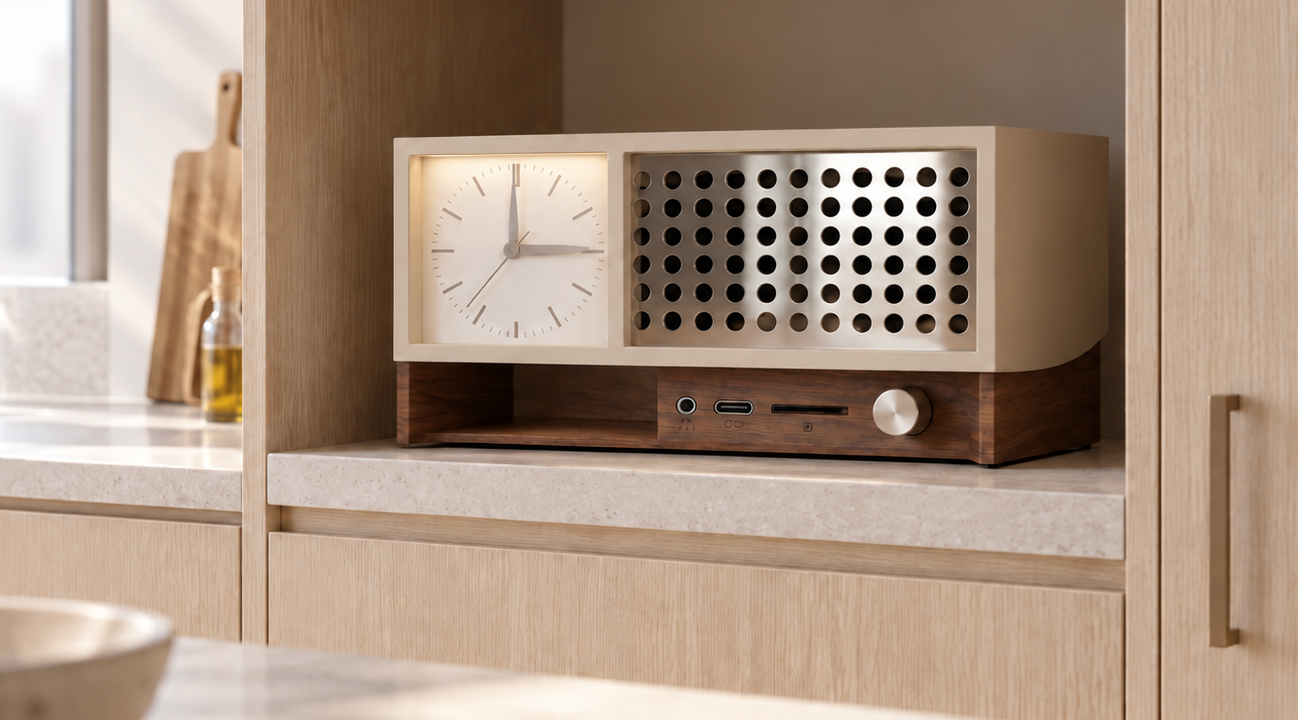
The final CAD model was then rendered in Keyshot to provide its core properties and material surfacing. For example deciding between brushed or polished steel for the speaker grill. Then the model was placed in several environments with the use of AI generation. This was to test the new advancements in AI image generation to speed up the design process for rapid modelling.

Detailed Design
I wanted the design architecture to be modular, to aid production simplicity and to reduce costs. This also allows easy repairs, swapping of components, and easy maintenance. As KINO is aimed primarily towards a niche audience, the expectation is that they would want to potentially upgrade components and maintain functional longevity.